Walk into a chemist in any Indian city and hand over a prescription for a blood pressure drug. The pharmacist will reach for a branded box Telma, Losar, Amlo and quote you a price that makes you count your wallet. What he probably won’t mention is the store three lanes over where that same molecule, same dose, same manufacturing standard, costs a fifth as much.
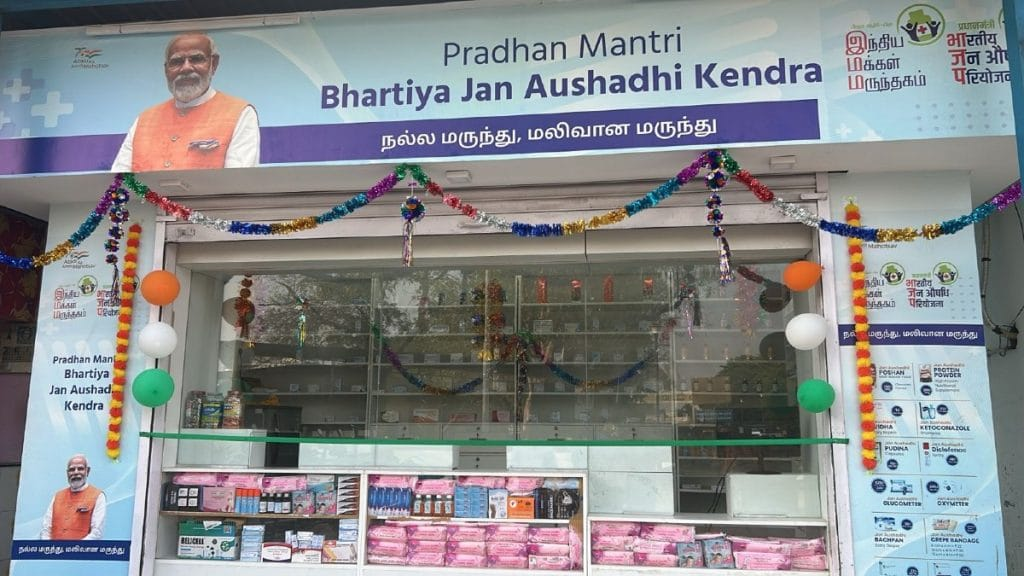
That store is a Jan Aushadhi Kendra.
The scheme was first launched in 2008, revamped in 2016, and built on a single idea: generic medicines at prices 50 to 90 percent lower than branded alternatives, sold through government-supported pharmacy outlets. The molecule does not change. The pill does the same job. The difference is the box it comes in and the marketing budget behind it.
What the scheme actually is
The Pradhan Mantri Bhartiya Janaushadhi Pariyojana runs under the Department of Pharmaceuticals and Ministry of Chemicals and Fertilisers, implemented by the Pharmaceuticals and Medical Devices Bureau of India. As of June 2025, the product basket covers 2,110 medicines and 315 surgical items and consumables, spanning anti-infectives, anti-diabetics, cardiovascular drugs, anti-cancer medicines, and gastrointestinal treatments.
Pricing follows a formula: medicines are priced at a maximum of 50 percent of the average price of the top three branded equivalents. In practice, savings often run deeper metformin for diabetes, omeprazole for acidity, and common antibiotics all cost a fraction of their branded counterparts.
The outlets themselves are called Jan Aushadhi Kendras. Anyone can open one individuals, NGOs, state governments, hospital trusts. The government provides setup support, a purchase discount, and a monthly incentive until sales stabilise. Store owners get assistance of Rs 2 lakh to Rs 50 lakh and a 16 percent discount on medicine purchases, which covers their profit margin.
The expansion numbers
In 2014, barely 80 Jan Aushadhi stores operated across India. The count today tells a different story entirely.
Between 2016 and 2025, around 14,000 new Jan Aushadhi Kendras opened across every state and union territory. The scheme consistently beat its own targets the goal of 10,000 Kendras was achieved ahead of the March 2024 deadline, and the 15,000-Kendra target for March 2025 was hit two months early.
As of June 2025, 16,912 Jan Aushadhi Kendras operate across India. The next target: 25,000 Kendras by March 2027.
The savings add up fast. In 2022-23 alone, PMBI recorded sales of Rs 1,235 crore, generating estimated savings of approximately Rs 7,416 crore for citizens. Over nine years, the scheme has saved citizens roughly Rs 23,000 crore.
By November 2023, over 15.87 crore Jan Aushadhi Suvidha sanitary pads had been sold through the scheme a detail worth noting because menstrual hygiene products were added specifically to address affordability for women in lower-income households.
Why doctors and pharmacists resist it
The numbers look clean. The reality at the counter is messier.
Branded pharma companies spend heavily on doctor relationships samples, conferences, commissions. A doctor who prescribes by brand name keeps that ecosystem running. The Indian pharma industry spends significant sums marketing to doctors, and many still prescribe branded medicines even when cheaper generics are available.
The Indian Medical Association pushed back hard when the National Medical Commission directed doctors to prescribe generics. The order was withdrawn within days after the IMA and the Association of Physicians of India opposed it. The message was clear: prescribing habits are not changing through directives alone.
Private chemists have their own incentive structure. They earn higher margins on branded products and have spent years building customer trust. Steering patients toward a Jan Aushadhi Kendra cuts into that.
The quality problem
The majority of Jan Aushadhi outlets fail to stock even 20 to 25 percent of the listed medicines, according to observers who have tracked the scheme closely. Stockouts are common. Medicines arrive close to expiry.
Quality failures have surfaced periodically. In 2018, PMBI recalled six batches of medicines including painkillers and antibiotics after state drug regulators found them substandard. Critics noted the agency’s reliance on state-level testing conducted only after drugs were already in circulation, pointing to weak pre-distribution checks.
Over four years, BPPI recalled 106 batches of 52 drugs. These included Telmisartan and Ramipril for blood pressure, Nimesulide for pain, and Calamine lotion. BPPI argues its sample failure rate of 0.44 percent compares well against the industry average of 2 percent a reasonable point, but cold comfort when the drug that failed is the one in your hand.
Patients reporting ineffective medicines, crumbling tablets, and prescriptions that run out have fed a growing crisis of confidence. Some stopped returning to Jan Aushadhi Kendras entirely.
All drugs procured under the scheme undergo quality assurance testing at NABL-accredited laboratories and must comply with WHO GMP standards. The system exists on paper. The execution is uneven.
What needs fixing
Three things stand in the way of the scheme reaching its potential.
First, supply reliability. Nothing kills trust faster than out-of-stock medicines. A real-time inventory system showing patients which Kendra has their medicine before they leave home would reduce wasted trips and stop people from giving up on the scheme after one failed visit.
Second, the doctor problem. Prescriptions by brand name still dominate. Without prescriptions that name the generic molecule rather than the brand, patients don’t walk into Jan Aushadhi Kendras they walk into the chemist who sells them what the doctor wrote. Pushing this change through penalties has already failed once. Incentives and education will have to do the work instead.
Third, public confidence in quality. Regular test results, published in plain language and backed by independent labs, would counter the persistent belief that cheap means low quality. Trust is built on proof, not promises.
The larger context
In India, millions who worked their way out of poverty get pushed back into precarious living by high healthcare costs, since the state provides very little support. One estimate puts the share of the population dropping below the poverty threshold each year because of healthcare expenses at 7 percent.
Jan Aushadhi addresses a real problem with a structurally sound approach. Generic medicine works. The chemistry is identical to the branded version. The scheme’s price model holds up. The expansion has been genuinely fast and broad.
What it hasn’t solved is the trust gap with doctors, with patients, with the supply chain. Nigeria sought India’s help in 2023 to replicate the Jan Aushadhi model for its own healthcare system, which suggests the concept travels well. Executing it consistently at home is the harder task.
Sixteen thousand stores is a real number. The test is whether patients leave those stores with the medicine they came for, confident it will work.
Leave a Reply